Sealed packs and booster boxes
What genuine vintage packaging looks like
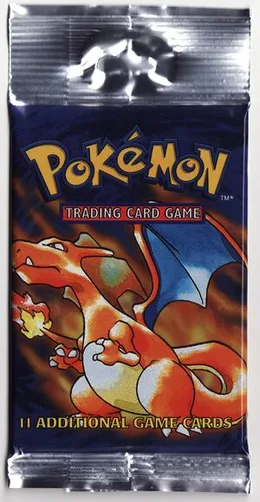
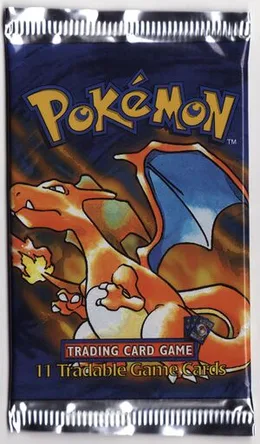
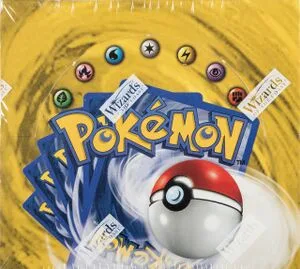
Look closely at the bottom line of the two packs: the wording is different. Packs from different print runs carry different text, so always compare a pack with genuine examples of the same set and print. Every set page on this site shows its pack designs and box.
Pack and box images © Pokémon / Nintendo / Creatures / GAME FREAK / Wizards of the Coast, via Bulbapedia, shown for identification only.
Booster packs: what to check
- Crimps. The top and bottom seals are pressed by machine and have sharp, even ridges right across. A reseal often has a smoother, flatter or slightly wavy crimp, or the two ends do not match.
- Glue. Run a finger along the back seam and the ends. Hard, crusty or shiny glue is the classic giveaway of a pack that has been opened.
- The wrapper. Look in good light for lifted areas, pinched corners, tiny holes, bubbles under the surface, or a faded patch where tape was used.
- The price. A "too good to be true" price on an old sealed pack is a red flag on its own.
Go deeper: why "weighed" packs are a thing
In some older sets a holo card made the pack slightly heavier, so people weighed packs, kept the heavy ones and sold the light ones. Loose vintage packs may already have been "weighed out", so the odds inside are worse than the set's normal odds. Many shops refuse to weigh packs for this reason, and a sealed box straight from the factory has not been touched. This is another reason to prefer a properly sealed box, or to buy the single card you want.
Booster boxes
- The shrink wrap. Modern English boxes usually come in wrap printed with evenly spaced white Poke Ball logos. Clear wrap with no logos on a modern English box is a warning sign. Logos can rub off with handling, so faded logos alone are not proof.
- The seams. Factory wrap folds into neat seams in the middle of the ends of the box. Seams running across the faces of the box, or a cut line that is perfectly straight and tight, suggest it was rewrapped with a heat gun.
- Air holes. Factory film has small air holes from the wrapping machine. A heat-gun reseal usually does not, though this is a hint, not proof on its own.
- The box itself. Check the tear strip on top for creases or splits, and the corners for crushing that does not match the wrap.
Go deeper: vintage boxes are a special case
Wizards of the Coast era boxes (1999 to 2003) did not use the modern logo wrap, and they are the most faked and resealed items in the hobby, because the reward is so high. Even experienced collectors have been caught out. For any vintage sealed box, compare it closely with photos of known genuine boxes from the same set, ask for its history, and use a specialist sealed-product authenticator before paying. If the seller will not allow that, walk away.
Go deeper: buying in bulk (wholesale)
If you are buying several boxes or a case, buy from an official distributor or a long-established shop that can show where the stock came from. Check every box on arrival before you sign anything off, photograph the wrap and seams, and keep the case and its labels. Pokemon is the most counterfeited trading card game, and fake stock moves in bulk too.
The labelled diagrams are our own drawings.