Grading and population reports
 12345
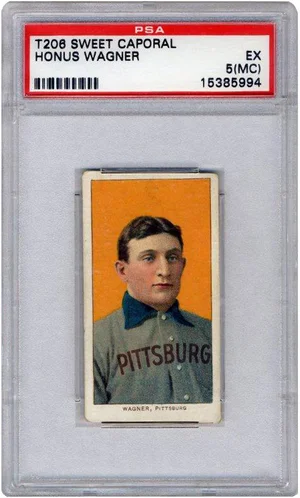
12345- 1 The card: year/set and name, printed by PSA.
- 2 The grade: "EX 5" means Excellent, grade 5. The (MC) after it is a qualifier: MC means miscut. Other qualifiers include OC (off-centre), ST (stain) and PD (print defect). A qualifier makes a card worth less than the same grade without one.
- 3 Certificate number: unique to this card. Type it into PSA's website to check the slab is real.
- 4 Barcode: holds the same certificate number.
- 5 The case: sealed all the way round. Cracks, gaps or glue marks are warning signs.
Photo: Wikimedia Commons, public domain.
The four grading companies, side by side
| Company | Scale | Top grades | Worth knowing | Check a slab |
|---|---|---|---|---|
| PSA | 1 to 10, with half grades | 10 Gem Mint | The biggest grader of Pokemon cards. May add a qualifier such as OC or MC. | PSA cert check |
| CGC | 1 to 10, with half grades | Pristine 10, then Gem Mint 10 (an older "Perfect 10" grade has been retired) | Has its own public population report, which this site uses. | CGC cert check |
| Beckett (BGS) | 1 to 10, with half grades, plus four sub-grades | Pristine 10; a "Black Label" means all four sub-grades are 10 | Sub-grades for centring, corners, edges and surface are printed on the label. | Beckett lookup |
| TAG | 1 to 10 with half grades (no 9.5), based on a 1,000-point score | Pristine 10, then Gem Mint 10 | Newer company that grades with computer imaging and publishes a report for each card. | TAG website |
A 10 from one company is not the same as a 10 from another: each has its own standards. Compare like with like.
Know your slab
Whichever company graded it (PSA, CGC, Beckett or TAG), a graded card sits in a sealed case with a label. The label layout differs by company, but the same five things are always there. Fake slabs exist, so always check the certificate number on the grader's own website.
Check a certificate number: PSA · CGC · Beckett · TAG. If the website shows a different card or grade, walk away.
Diagram drawn by us. We do not show the companies' logos, and this site is not connected to any grading company.
The scale in plain English
| Grade | What it means |
|---|---|
| 10 | Perfect or as close as possible. Sharp corners, centred, no marks |
| 9 | Near perfect, one tiny flaw |
| 7 to 8 | Clean card with small, visible wear |
| 5 to 6 | Played with, clear wear on edges or corners |
| 1 to 4 | Heavily played or damaged |
Go deeper: how to read a population report
Look up the card on the grading company's site (CGC's is free to view; PSA now asks you to sign in first). You will see a row for each grade. Two things to watch:
- The top grade count. If only a handful of copies are a 10, those few are the scarce ones.
- How fast it grows. Some old cards barely move. The 1st Edition Charizard PSA 10 count grew from about 120 to about 125 over several years.
Population is not the same as how many exist. It only counts cards someone has sent in. Resubmitted cards can also be counted twice until the old label is removed.